Before I even set about writing this post, I had to do a bit of research into what makes a smartphone camera click. I’m talking about the technology that allows a phone’s camera lens to produce a fine quality image, and also the software and hardware that helped make that happen.
I’ve never really understood camera technology, especially on smartphones, and this seemed like the perfect opportunity to learn something new – it’s not all about the megapixels!
There’s the aperture f-stop, for example, or the pixel size; sensor size; Optical Image Stabilisation; what HDR does (okay, that last one I do know!).
But how do all these come together to make a great-looking photo – that you can then share on Instagram? Let’s dig deeper…
There are many settings that can affect how an image looks, but I’m more interested in what makes a high resolution image. How is it that some phones can produce a sharp image, but others produce an image with a lot of noise or rely heavily on image processing?
Aperture and f-stops
Let’s start with the aperture f-stop. It’s that weird number with an ‘f’ and forward-slash (e.g. f/2.4) that you’ll see on a website such as Carphone Warehouse, or Argos, or a GSMArena specs sheet.
The ‘f-stop’ name comes from the first part of that figure, f/, and together with the number, it is actually a calculated fraction.
For everyday smartphone camera users like you and I, how that figure is calculated is irrelevant. It’s what it’s telling us, and how small the figure is, that’s really important.
So… why is it important?
The f-stop tells us the limits and abilities of a smartphone camera – useful info to know before purchasing a phone. It could be the difference between walking away with a capable DSLR-beater, or wasting £500+ on a phone with a sub-par camera.
Basically, a smaller number means a bigger aperture. This confused me at first, but what made it easier to understand was remembering what I learnt at a young age, when I was being taught how to play the guitar:
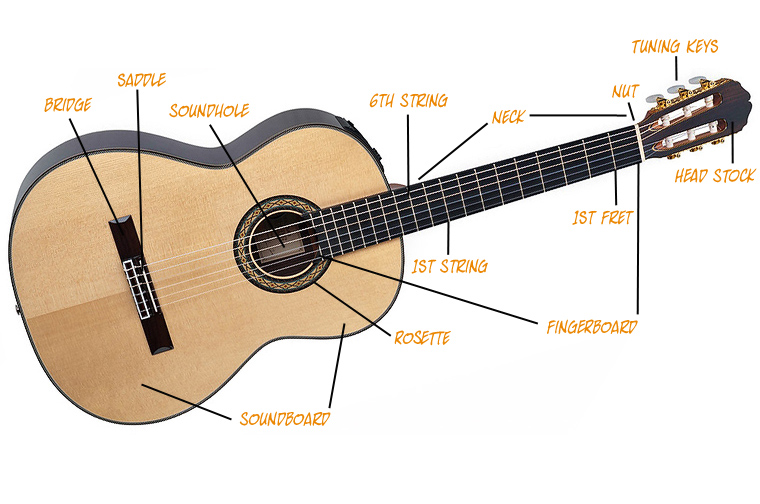
On a right-handed guitar, the higher-pitched notes are played on the physically-lower strings on the neck, whereas the low notes are played on the physically-higher strings – indicated above in the diagram above as 1st and 6th strings respectively.
To bring this analogy back to aperture on phone cameras, the opposite to what it looks like is true. An aperture of f/32 looks like it’s bigger than f/2.0, because in number terms we know that 32 is bigger than 2. But, in camera technology, the opposite is true – an aperture (or, hole or opening) of f/32 is much, much smaller than an aperture of f/2.0.

You won’t find a smartphone with an aperture of f/32, as the aperture is often fixed at its biggest setting. You’ll only find f/32 on a DSLR lens, that can be adjusted to the desired aperture setting.
Watch the video below if you’re still confused, which offers a very helpful, if in-depth explanation on aperture – it certainly helped me!
As he explains, the smaller the number is, the bigger the aperture is, and a bigger aperture means the camera lens will let in more light.
In theory, that means that the f/1.7 aperture of the Samsung Galaxy S7 should let in more light to its sensor than the f/2.0 aperture does on my HTC Desire Eye.
In theory, this means the Galaxy S7 should be better in low-light conditions than my Desire Eye, as it’s aperture lets in more light.
Sensor Size
But, smartphone photography is not just about aperture. The size of the sensor can also play a major role in how bright or dark an image will be.
The sensor size will be given as a fraction: 1/3″, that of the iPhone 6s.
Like the aperture rating, the size of the sensor is also important, as a bigger sensor is likely to perform better in low light conditions.
A small sensor with a high pixel count means that you compromise on the pixel size, which is never a good thing for image quality.
Samsung’s Galaxy S7 benefits from a 1/2.5″ sensor, which can accommodate a pixel size of 1.4 microns, but is half an inch smaller than that of the iPhone 6S, so image quality will definitely vary between the two devices.
Pixel Size (Microns)
Pixel size is also important to image quality. On a smartphone spec sheet (see gsmarena.com for examples), it’s measured in microns and looks like this: 1.25µm (that of the LG G5).
Pixel size, as with sensor size, will affect the final quality of each photo that you capture.
Generally speaking, a phone with a small sensor and small pixel size will produce poorer quality images than a phone with a big sensor and a bigger pixel size.
Of course, smartphone manufacturers rarely advertise pixel or sensor size, in favour of the megapixel (MP) count.
Generally, we’ve all been misled into believing a higher MP count means that camera will be better than a lower MP count – and, generally, higher numbers will sell phones in higher numbers.
HTC tried to utilise their UltraPixel technology on the HTC One M9 to achieve better quality images.
That phone came with two lenses, a 4MP sensor and secondary UltraPixel one that measured depth and lighting details. But the fact that its flagship phone had the lowest megapixel count did HTC no favours, and it’s why companies like Samsung flourished by offering phones with 16MP cameras.
Links:
Below are some pages I found helpful when conducting this research:
http://www.techspot.com/guides/850-smartphone-camera-hardware/page2.html
http://newatlas.com/smartphone-camera-aperture/42524/
http://www.techspot.com/guides/850-smartphone-camera-hardware/page3.html
http://www.trustedreviews.com/opinions/best-camera-phone-features
http://www.phonearena.com/news/Smartphones-with-the-widest-camera-apertures_id64763
– Chris JK
 KPH tech blog
Leave a comment