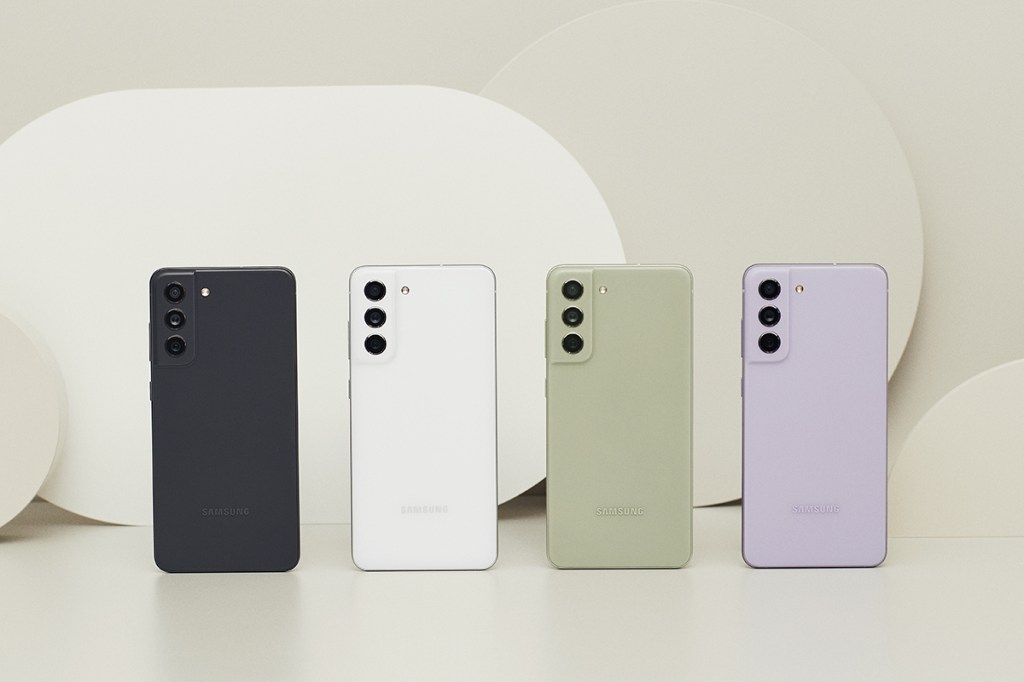
When choosing a budget or mid-range phone over a flagship, it’s often Sacrifice Boulevard when you look at the specs sheet.
Because in order to make it a budget or mid-range product, it’ll cut corners – those ‘sacrifices‘ – in order to also cut the price.
My ownership of the base Galaxy S21 ‘flagship’ is fast approaching the 1 year milestone. As a new phone, I’ve loved it so far.
But with Samsung releasing the Galaxy S21 FE this week, I thought I’d take a look at the reasons the newer Fan Edition might appeal over the three S21 flagship models, and why it wouldn’t.
Fan Edition vs Flagship
It’s no secret that to cut the price, a manufacturer will also cut down on the specs & features of a device.
The S21 FE is no different. While on paper it looks similar to last year’s Galaxy S21 5G, if you look a little closer, the S21 ‘Fan Edition’ has some differences.
For starters, the build quality isn’t as good as the Galaxy S21 flagship range. Sure, that’s not a major issue given that the Fan Edition is the budget-friendly option. But it’s worth noting.
Although my Galaxy S21 has a glasstic back panel, the metal frame seamlessly curves around to the camera bump. On the newer S21 FE, however, you still get a metal frame and the curves, but if you look closely (& as MKBHD notes on his hands-on video) the camera bump is now a separate entity to the frame.
While this takes away from the aesthetics of the S21, this could be a good thing for durability.
That’s not to say I’ve had a problem with my Galaxy S21, but I have had it in a case since the day it arrived – so durability isn’t something I’ve had to worry about.
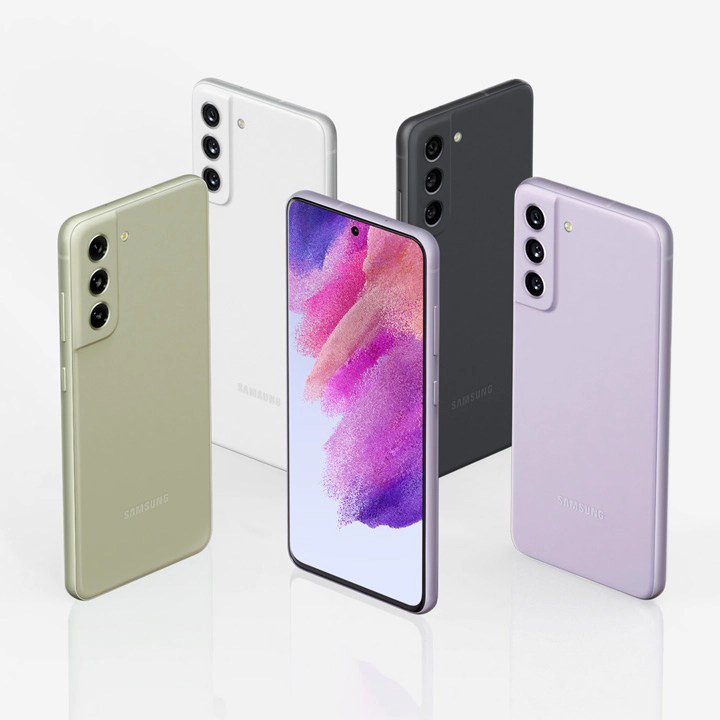
Ultimately, as the S21 FE is supposed to be more budget friendly, it’s aesthetics don’t really matter. That said, if you’re in a market where the smaller S21 is now on sale or heavily reduced, it’s by far the better looking of the two phones.
Chipset
The S21 FE’s SoC is almost universally the Qualcomm Snapdragon 888 5G. That’s big news, especially here in Europe.
The Galaxy S21 flagship range had both Snapdragon and Exynos variants, as did the Galaxy S20 FE.
But this time around, there’s no sign of Samsung’s own Exynos SoC in the new S21 FE – at least not for the US or Europe.
In Europe, we normally get the Exynos variants instead of Snapdragon, so to see this shift is pleasing.
That said, as Gizmochina reports, there is a planned Exynos variant of the Galaxy S21 FE coming to Asian markets – but, which areas it will come to specifically, is unknown at time of writing.
Pre-Exnos 2100, Samsung phones running on Exynos SoC’s were typically slower and more power hungry than Samsung devices running on a Qualcomm SoC. It was specifically an issue with the Galaxy S20 models, as well as the Galaxy S20 FE 4G – the 5G variant of the S20 FE had the Snapdragon 865 5G SoC.
I personally haven’t had any issues to report with my Galaxy S21, which has the Exynos 2100 SoC. I’ve had no slowdowns and no battery issues. Thus far, it’s been perfect – but I realise that others may have had issues, so a shift to all Qualcomm is, as I said, pleasing.
Storage & RAM
The S21 was available in 2 guises, both with 8GB RAM – 128GB storage & 256GB storage. That made losing the Micro SD card slot an easier pill to swallow.
That’s also something that’s missing on the S21 FE that was available on the S20 Fan Edition: the Micro SD card slot.
If you’re used to using a 128GB phone with a Micro SD card as well, you might just feel the pinch this time around, and may need to opt for the 256GB model.
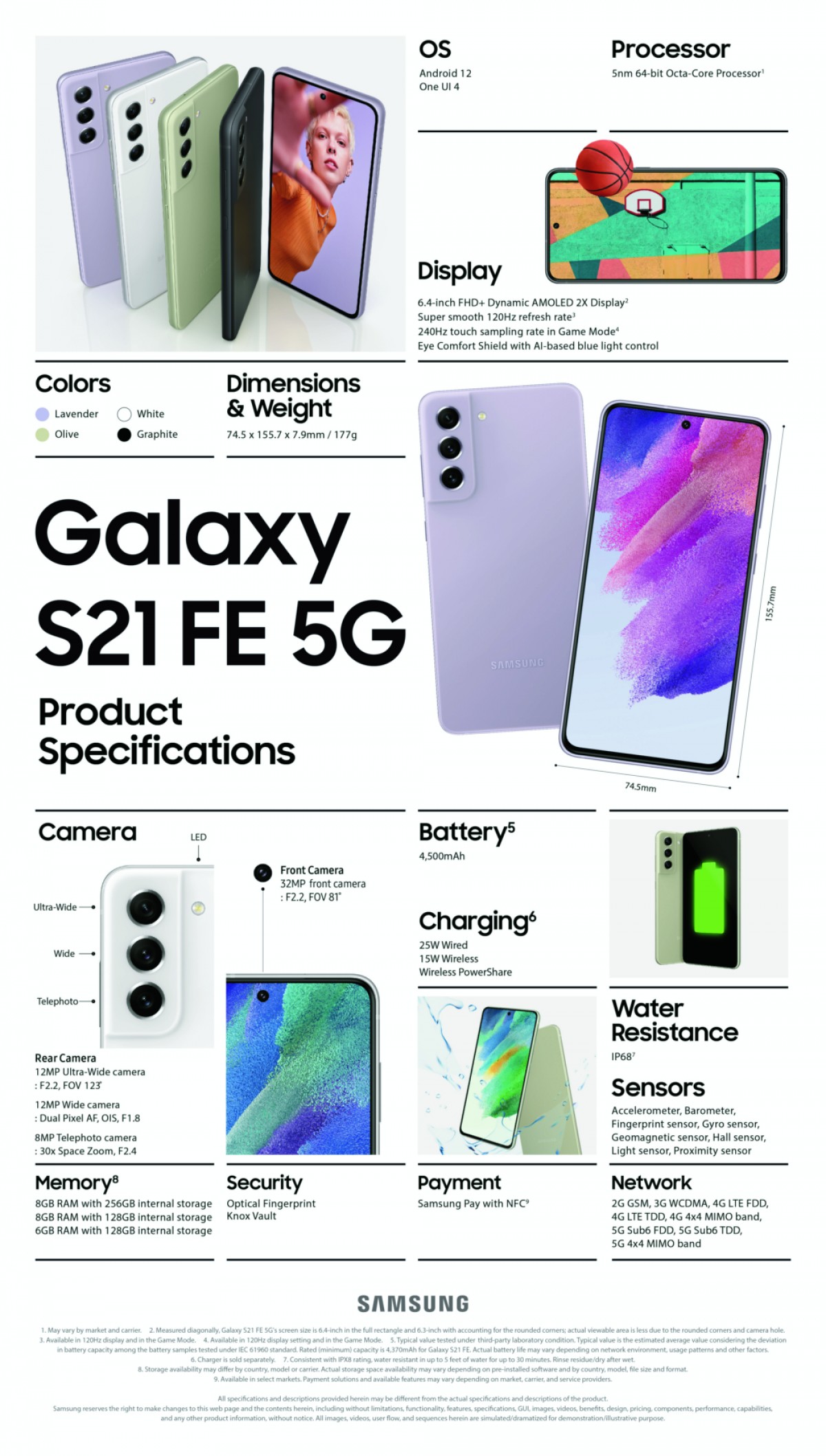
However, if that isn’t the case, the S21 FE has the same 128/8 and 256/8 combo’s as the Galaxy S21, and adds a third new variant – 128GB storage & 6GB RAM.
But given that the Android OS has [historically] tended to use about 4-6GB RAM, it’s probably best to avoid this model if possible.
Personally, my Galaxy S21 (with 8GB RAM) is still working as smooth as it did on Day 1.
Also, as an Android veteran, I’d advise sticking to a minimum 8GB RAM if you’re going to get the S21 FE. You’ll be fine with 6GB, and will be able to run most apps and games simultaneously without hiccups. But for the smoothest experience, you’re better off with an 8GB model.
Cameras
This is where you’ll spot the main differences from the Galaxy S21.
The S21 FE swaps out the S21’s 64MP telephoto camera (with 1.1x optical zoom & 3x hybrid zoom) for an 8MP telephoto camera.
While that may seem worse, it’s optically better with a focal length of 76mm.
The main camera of the S21 was 26mm, with the 29mm telephoto camera relying on pixel binning and processing to achieve the same result.
As the S21 FE has a 76mm lens, it should be optically better – though we’ll have to wait for camera samples to see for ourselves.
Also, the ultrawide camera has received a boost to the field of view, although it’s only a small boost: 123°, from the S21’s 120° degree FOV.
On the selfie front, the megapixels have been boosted from 10MP on the Galaxy S21, to 32MP on the Galaxy S21 FE.
Features & Connectivity
The only major changes to note thus far are as follows.
The fingerprint reader on the S21 FE is an optical sensor. It’ll be inferior to the ultrasonic readers on the S21, S21+ and S21 Ultra, but has been changed to reduce the launch price of the phone.
As yet there’s also no Samsung DeX support in the S21 FE, but this could come in a future software update.
Obviously, because it’s a bigger phone than the S21, the S21 FE receives a battery boost as well. The capacity has been raised to 4,500 mAh, although it should be noted that the batteries in the S20 FE, S21+ and S21 Ultra were all higher at 4,800 mAh.
Although the S21 FE has a 0.2″ inch larger screen than the S21, it’s the same resolution, and with that extra 500 mAh it should mean the S21 FE offers a longer battery life than the Galaxy S21.
Also, the S21 FE is rated at the same 25W Fast Charging as the S21, but it’s unclear at this stage if it supports USB Power Delivery 3.0. With the larger battery capacity, it might mean a longer charge time for the Galaxy S21 FE than the 1hr 13mins of the Galaxy S21 – even though the S21 FE has been advertised as being capable of a 50% charge in 30 minutes.
The 15W wireless charging is also the same as the S21, but again supported technologies haven’t yet been confirmed, so it’s unclear whether Qi and PMA chargers are supported.
(I’ll publish an updated blog when I know more.)
Pricing & Competition
The base Galaxy S21 flagship is currently available here in the UK for £599, with the newer Galaxy S21 FE starting at £699 and maxing out at £749.
While that may seem competitive, the 6.4″ screen isn’t large enough to warrant that extra money.
It’s also unclear if the S21 FE will receive as many OS updates as the rest of the Galaxy S21 range, especially as it’s the more budget-friendly flagship.
While it will qualify for the extended Security Policy of 4 years of Samsung security updates, it’s not clear if the S21 Fan Edition will receive the same number of OS upgrades as the rest of the range – S21, S21+, & S21 Ultra.
That said, the battery capacity is 500mAh bigger, so that might be worth it – and the launch price will be lower in markets where discounts aren’t always available for the better models.
That means, in other economic markets, the S21 FE will likely be cheaper than the older S21 – and offers a few upgrades for less money.
But it should be noted that it also comes with a few downgrades as well.
Also, for the price of £639, the OnePlus 9 offers much better value for money than the S21 FE at launch. It comes with a 6.7 inch LTPO Fluid 2 display, with 120Hz refresh rate and a better screen resolution at 3216 x 1440p – superior to the S21 FE’s 2400 x 1080p.
The OnePlus 9 also has a 256GB variant with 12GB RAM, and has a quad camera setup on the rear – 48MP main, 8MP telephoto, 50MP ultrawide, and 2MP Monochrome camera.
The OnePlus 9 Pro has the same battery capacity at 4,500 mAh, but can charge much quicker thanks to the Warp Charge 65T tech – 0-100% in under 30 minutes.
It’s 50W wireless charging is quicker too, with a full 0-100% charge taking just 43 minutes.
If you’d rather wait for the new OnePlus 10 Pro, prices are unavailable as yet but it’s rumoured to launch with a 5,000 mAh battery, 80W Fast (wired) Charging, and 50W wireless charging – which should mean even quicker charge times than the already lightning fast speeds of the OnePlus 9 Pro.
Wrapping things up
You may still want the S21 FE, but if you browse around, there are better value propositions out there.
Unfortunately, given that the S21 FE is late to the party, many people may opt instead to wait for the the launch of the newer Galaxy S22 phones, or wait for incoming discounts of the S21 range.
That may mean its fate is already sealed, even before it’s initial launch.
– Chris JK.
 KPH tech blog
Leave a comment