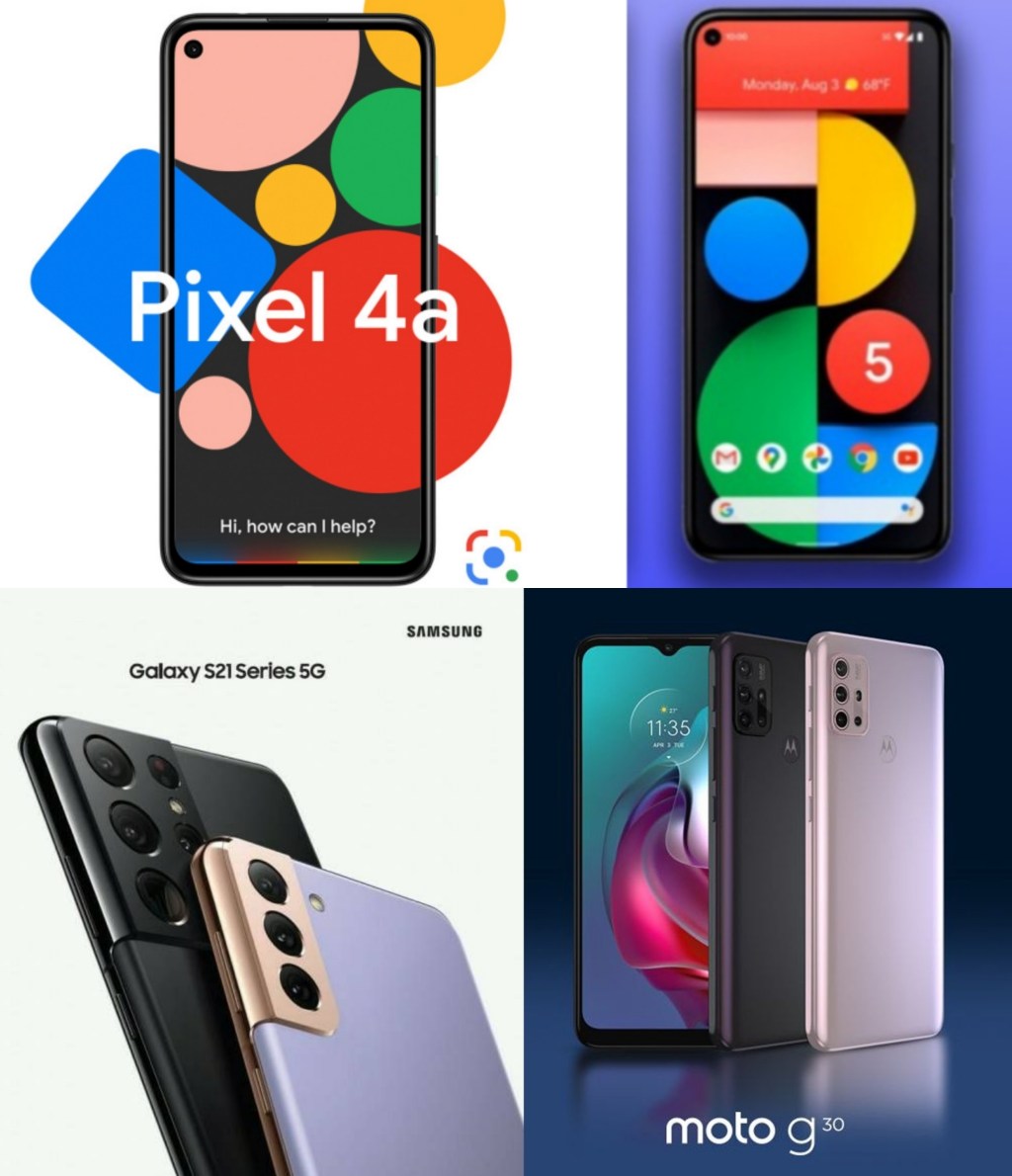
Right. I’ve now posted about the Moto G30, the Pixel 4a, and the Pixel 5. I’ve considered everything that is relevant to me, and have decided that the Pixel 4a and Pixel 5 are sadly no longer in the running.
That means it’s now between the Moto G30 and Galaxy S21 – the final four becomes the final two…
And since I’ve already blogged about the Moto G30, and reviewed it, that leaves just the Galaxy S21 to blog about:
Galaxy S21: Performance
Having read about performance issues with the Exynos 990 chipset of the Galaxy S20 and Galaxy S20 FE, I dropped those two devices off my shortlist and added the new Galaxy S21, which comes with a [hopefully] much-improved Exynos 2100.
Given that I live in an Exynos region, there’s really no escape from Samsung’s chipset – so it’s really all about the one that performs the best.
Galaxy S21: Price & Size
I’ve opted for the Galaxy S21 in my shortlist, rather than the S21+ and S21 Ultra, purely because of its smaller size. I accept there will be compromises, but as long as screen & device size isn’t one of them, then I’ll take whatever I can get at this stage. Especially since I’ve now ruled out both the Pixel 4a and Pixel 5.
Released two months ago this year, in January 2021, it’ll be the first phone that breaks my rule of getting the previous outgoing model on the hopes of it being cheaper.
To my surprise, the Galaxy S21 is £200 cheaper than the Galaxy S20 – so I’m definitely not the only rulebreaker here!
Galaxy S21: Screen
It comes with a 6.2″ screen – matching the screen of my S9 Plus, but thankfully on a smaller chassis, meaning the device as a whole should be a bit more manageable for my hands.
That 6.2″ screen is a Dynamic AMOLED 2X, with a maximum refresh rate of 120Hz, and support for HDR10+ content.
According to GSMArena’s spec sheet, the Galaxy S21’s screen also has 1300 nits of peak brightness, so it should be more than useful outdoors in bright sunlight.
The resolution does drop to 1080p – my S9 Plus has a 1440p screen, as does the S21 Ultra – but it’s a compromise I’m okay about. Mostly, because I’ve got a much bigger 2560 x 1600 screen on my Tab S5e for movies and TV shows, and also because Samsung’s displays tend to be the best in the market – and, having had an S7 and an S9 Plus, I’ve got plenty of experience of that!
Galaxy S21: 8GB RAM, 256GB storage, but no 3.5mm
Unlike the Moto G30 and Pixel 4a, the Galaxy S21 matches the Pixel 5 in the memory department – 8GB RAM – but has the option for way more storage than the Pixel 5.
That’s right – the Galaxy S21 is available as a 128GB model, or a 256GB model. Given that the Galaxy S21 also lacks a Micro SD card slot, the fact that there’s more internal storage means that the lack of expandable storage won’t be such a hard pill to swallow.
The Galaxy S21 lacks a 3.5mm headphone port, but as I said before about the Pixel 5, I’m okay with losing one of either the 3.5mm port or Micro SD card slot features, but not both at the same time – unless a solution to the storage problem is provided. And, with a 256GB model, Samsung has provided…
Galaxy S21: Camera
On the camera front, it has three cameras in the rear: a 12MP main camera, 12MP ultrawide sensor, and a 64MP telephoto camera.
Whilst the telephoto only has 1.1x optical zoom, with a 3x hybrid zoom – meaning it’s 1.1x optical and 1.9x digital – the 64MP sensor outputs images at 12MP, meaning the extra resolution is there to make up for the lack of hardware zoom.
According to GSMArena, although the telephoto camera has a “regular-Bayer RGB sensor, albeit one with tiny pixels, it can actually capture more granular color gradation data than a Quad Bayer/Tetracell counterpart.”
Hopefully, that means the hybrid zoom on the 64MP sensor will help to capture ‘lossless’ photo’s – similar to what Google has tried to do with the SuperRes technology on the Pixel 4, Pixel 4a and Pixel 5.
Certainly, test shots and early reviews show the images looking very impressive despite the smaller S21’s hardware compromises – and, somewhat on a par with (if not, better than) an iPhone 12’s photos.
That would be great, as I’ve never really been a fan of the warm yellow hues of Samsung’s cameras in low-light photo situations. It’s just been a compromise I’ve had to contend with, knowing I’ve got an otherwise perfect phone for me in my hands.
Samsung’s apps suite, and One UI
I like that the Galaxy S21 still comes with Samsung’s apps suite – My Files and Gallery I find particularly useful, and One UI as a whole just seems a bit more fluid and easy on the eyes, very customisable – thanks to the Good Lock app – and functional, thanks to the tie-in’s with Microsoft Office apps.
Being a brand new phone, it comes with Android 11 out of the box, and comes with Samsung’s promise of 3 generations of updates. That means it’ll be supported until at least Android 14 – which should arrive in Autumn 2023.
Nov 2021 update: Samsung has now upgraded this promise to 4 years of updates, rather than the previous ambiguity of ‘3 generations’ – so the Galaxy S21 should now be supported until at least 2025. That puts it almost within range of the quality of iOS support. My iPhone 6s, for example, was released in 2015 and is still receiving iOS updates in 2021 – most recently, it got the update for iOS 15.1!
Galaxy S21: Features
The Galaxy S21 also has NFC support, and a front/under-display fingerprint reader – which is bigger than the S20’s scanner and should therefore be more reliable.
I like the fact that it’s on the front. It’s something I liked about my Galaxy S7 – the first phone I had with a fingerprint sensor – and, in my opinion, is a more convenient place for the sensor to be.
Round the back and out of the way, like it was on my S9 Plus, meant I often relied on the face scanner omyn S9 Plus – which, happily, is also present on the Galaxy S21.
Galaxy S21: Battery, Charging
Like with the Moto G30, Pixel 4a and Pixel 5, USB-C and OTG support are also here, as is a large 4,000 mAh battery – 500 mAh bigger than the 3,500 mAh battery in my S9 Plus.
Also present is the 25W Super Fast Charging – powered by Power Delivery 3.0. That means a full charge in about 1hr 13 mins – a massive improvement given that my S9 Plus currently takes 1hr 35mins to fully charge.
On the downside, unlike the Galaxy S20, the Galaxy S21 doesn’t come with its own adapter in the box – copying Apple in that regard. It does unfortunately mean that I’d need to acquire a new charger with support for PD 3.0 – but, that’s not such a bad thing.
My current charger is a 2x USB plug with support for 18W charging and Quick Charge 3.0 – but wouldn’t be powerful or fast enough to support the 25W Super Fast Charging mode of the Galaxy S21.
I’d need a new 2x USB plug, but as you can see, it’d be a charger with two USB ports, not one – if the Galaxy S21 came with an adapter, it’d only have one USB port. It’d therefore not be as useful to me, as I like to use the same plug to charge up both my phone and my tablet – my current 2x USB adapters are capable of this.
If I could get a new GaN charger with support for 60W+ charging, meaning 30W per USB port, that would be enough power for both my phone and tablet.
It’s something to consider, at least, and although I would welcome the Galaxy S21’s faster charging speeds with open arms, the new technology – and requirement of new charging adapters – would also be something of an inconvenience.
Galaxy S21: Verdict
That said, a minor inconvenience, given that Samsung and other manufacturers might use PD 3.0 for some time to come, and if that becomes the case, it’s a short term inconvenience.
Also, needing to source an adapter myself means I get to choose what I want, rather than having another charger that I won’t use – the charger for my Tab S5e is still in the box, in its original packaging. I’ve never used it, nor needed it.
That aside, if I had to be honest, the Galaxy S21 as a whole is very impressive. I wish it was the same size as the Pixel 4a, but apart from that, it ticks nearly every other box in my checklist.
I didn’t want a Samsung for my Next Phone – I wanted a change. But the Galaxy S21 looks like it’ll be difficult for me to ignore.
The Galaxy S20 was almost perfect, save for its poor-performing Exynos 990 chipset. Hopefully that’s something the S21 won’t suffer from with the Exynos 2100, as the rest of the device is exactly what I’m looking for in a new phone.
If it does end up being my next phone, at least I haven’t just picked a Samsung because it’s a Samsung. At the very least, I’ve considered other brands first, before even laying eyes on Samsung’s new phones.
And that feels like a great place to end this blog post. In my next post, I’m putting the Moto G30 and Galaxy S21 up against each other.
But as I’ve already covered both devices in-depth, I won’t go into such depth again. Instead, I’ll focus on which device is better suited to me. It won’t be easy, but I’ve got to choose.
Stay tuned for more!
– Chris JK.
 KPH tech blog
Leave a comment